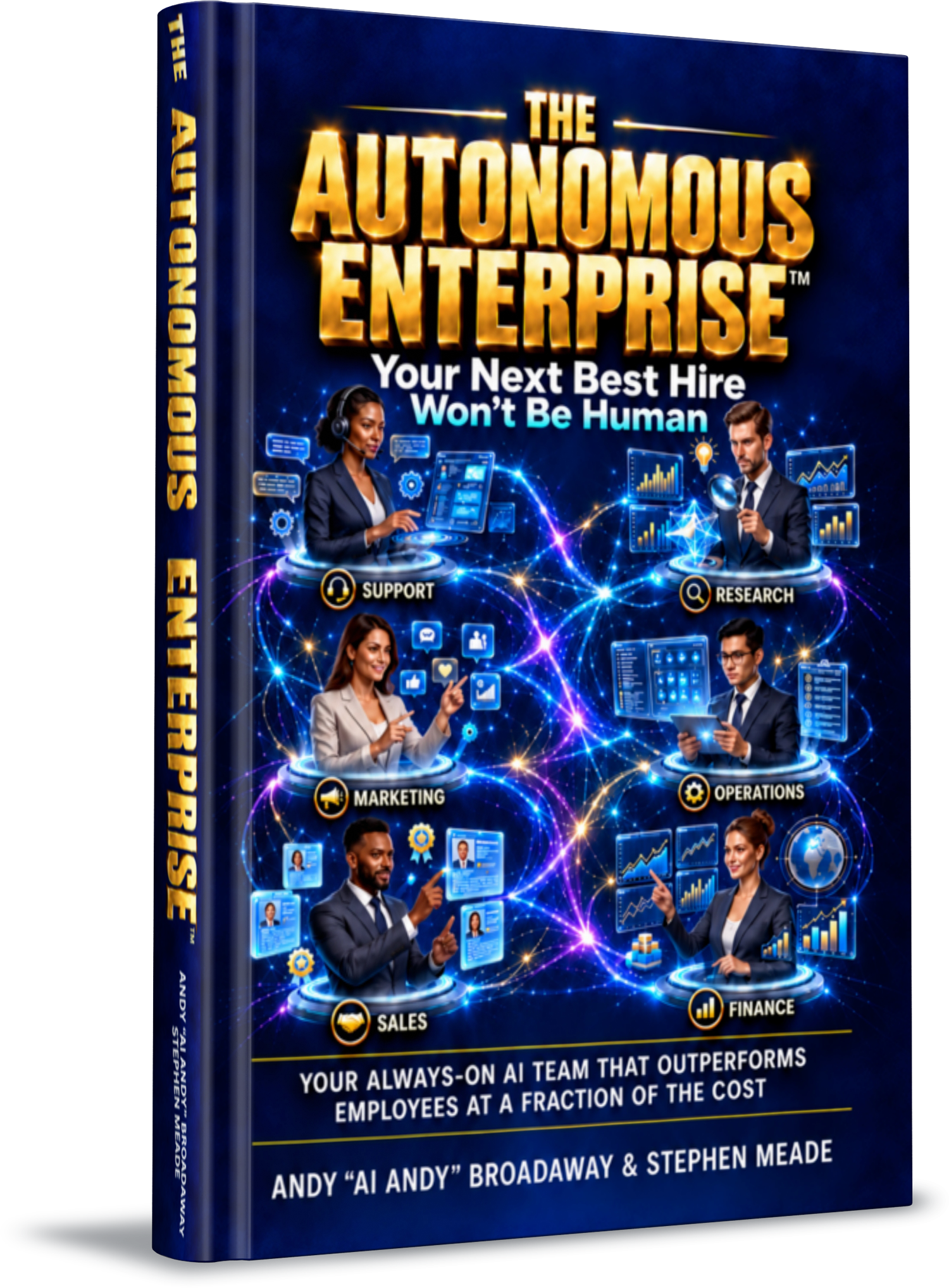
The Autonomous Enterprise™

Build an AI-Powered Company. Keep People in Control.

Discover AutonomousAgentOS™—a practical framework for turning AI agents into accountable business operations. Choose the right workflow, define what success looks like, and build the oversight your company needs before you scale.

Six governing principles. Four human roles. A structured 90-day deployment plan.

The Autonomous Enterprise by Andy 'AI Andy' Broadaway & Stephen Meade — Book Cover
The Business Problem

Your Company Needs More Than Another AI Tool.

An impressive demonstration does not tell you how AI will perform inside your business. The real questions are which work it should handle, what it is allowed to do, who is accountable, and whether the results justify the investment.

  • Your team spends valuable time on repeatable work.
  • Leads, customer requests, and internal handoffs can wait too long.
  • AI experiments lack clear owners and measurable outcomes.
  • Adding tools can create complexity without improving operations.

AutonomousAgentOS helps you answer the operating questions before you make the technology decision.

What AutonomousAgentOS Is

An Operating Framework for Your Company's AI Agents.

AutonomousAgentOS™ is a methodology for deciding where AI agents belong, how they should operate, and how people stay accountable. It connects business goals, defined workflows, operating limits, human oversight, and measurable results in one deployment approach.

Your company selects the technology. The framework helps define the mission and the rules it must follow.

Illustration — not a software interface

  1. Define the outcome
  2. Design the mission
  3. Establish controls
  4. Launch and measure
  5. Capture learning

Process: Define the outcome, then Design the mission, then Establish controls, then Launch and measure, then Capture learning.

Company Benefits

What Could This Change for Your Company?

The value comes from improving a specific workflow—not simply adding AI. Depending on the workflow, implementation, and oversight, your company can pursue:

More capacity for valuable work

Let appropriately configured agents handle bounded, repeatable steps so your people can spend more time on relationships, decisions, and exceptions.

Measure: human handling time and time available for higher-value work.

Faster response and follow-through

Support routine inquiry handling and follow-up across extended hours, with clear handoffs when a person is needed.

Measure: first-response time and unresolved-request backlog.

More consistent operations

Use documented missions, approved information, and defined escalation rules to make routine work easier to repeat and review.

Measure: rework, error rates, and escalation quality.

Clearer investment decisions

Choose technology against a defined business mission, then compare results with the full cost of implementation and oversight.

Measure: cost per successful outcome and total operating cost.

Control as you expand

Define permissions, action limits, monitoring, and stop conditions before more work moves to AI agents.

Measure: exceptions, unauthorized actions, and time to detect and resolve issues.

Knowledge your company can reuse

Capture mission designs, exceptions, and lessons in a Mission Library so later deployments build on what your team has learned.

Measure: reuse of documented practices and time to prepare the next deployment.

These are potential benefits and suggested measures, not promised outcomes. Results depend on your workflow, data, systems, people, and implementation.

Practical Company Use Cases

Start With One Workflow That Matters.

These examples illustrate where the framework can be applied. They are not prebuilt AutonomousAgentOS software features.

Sales and lead follow-up

Agent contribution
Respond to routine inquiries, collect approved qualification details, and route suitable prospects.
Human responsibility
Negotiation, unusual commitments, sensitive situations, and relationship decisions.
Measure
response time, qualified handoffs, and follow-up completion.

Customer service

Agent contribution
Answer approved questions, retrieve permitted information, and classify requests.
Human responsibility
Complaints, distress, disputed policies, and exceptions beyond the agent's authority.
Measure
verified resolution quality, escalation accuracy, and backlog.

Operations and administration

Agent contribution
Extract document information, update permitted records, and prepare routine status summaries.
Human responsibility
Approve exceptions and consequential operational decisions.
Measure
cycle time, rework, and exception volume.

Marketing and research

Agent contribution
Prepare drafts and summarize approved sources for team review.
Human responsibility
Verify claims, decide positioning, and approve publication.
Measure
preparation time and revision requirements.

Finance administration

Agent contribution
Extract invoice details, flag discrepancies, and prepare review queues.
Human responsibility
Authorize payments, approve financial decisions, and resolve discrepancies.
Measure
processing time and accuracy of flagged exceptions.

HR and onboarding

Agent contribution
Answer approved policy questions and coordinate onboarding steps.
Human responsibility
Hiring decisions, employee relations, and sensitive personal matters.
Measure
administrative handling time and onboarding completion.
The Framework

Six Principles That Make AI Work Accountable.

01

Mission Over Task

Give every agent a defined workflow, a measurable outcome, and clear boundaries.

Company benefit: effort stays connected to business value.

02

Full Auditability

Design records that make actions, relevant outputs, and human reviews traceable.

Company benefit: your team can investigate problems and improve performance.

03

Defined Blast Radius

Limit what an agent can access, change, or commit to through implemented controls.

Company benefit: failures have a bounded impact.

04

Human Sovereignty

Keep named people responsible, with authority to intervene.

Company benefit: consequential decisions retain human accountability.

05

Data Sovereignty

Establish how company data is accessed, stored, used, and retained, including vendor terms.

Company benefit: your knowledge is managed as a company asset.

06

Compounding Intelligence

Capture and reuse lessons from each deployment.

Company benefit: the next workflow starts with accumulated experience.

Stating these principles does not automatically implement technical controls or guarantee compliance.

Four Human Roles

AI Handles the Defined Work. People Own the Decisions.

Architect

Defines the mission, boundaries, and success criteria.

Referee

Reviews behavior and performance, with authority to pause or escalate.

Relationship Owner

Handles complex interactions and exceptions requiring human judgment.

Data Steward

Captures learning and maintains the knowledge that supports future deployments.

These are functional responsibilities—not necessarily four new hires. Existing team members may hold the roles, with clear ownership and sufficient time to do the work.

The 90-Day Plan

A Structured Path From First Mission to Measured Deployment.

The 90-Day Operator organizes implementation into four phases. The timeline is a planning target, with progress dependent on data readiness, integration needs, and successful review gates.

  1. 1

    Days 1–21

    Mission Architecture

    Define the workflow, success measures, boundaries, human roles, and data requirements.

    Deliverable: Mission Architecture Document.

  2. 2

    Days 22–42

    Governance Build

    Implement permissions, audit records, monitoring, escalation rules, and review procedures.

    Deliverable: Tested controls and review process.

  3. 3

    Days 43–63

    Governed Launch

    Begin with limited volume and expand only when performance and oversight justify it.

    Deliverable: A measured production workflow, subject to launch criteria.

  4. 4

    Days 64–90

    Learning and Roadmap

    Review results, document lessons, refine the mission, and plan subsequent deployments.

    Deliverable: Mission Library contributions and a twelve-month roadmap.

Start with a workflow that has repeatable volume, clear success criteria, a manageable failure impact, usable data, and a named accountable leader. Address readiness gaps before starting the deployment clock.

Maturity Curve

Where Is Your Company Today?

1Level 1

Manual Operations

No systematic AI deployment; use may be absent or informal.

2Level 2

AI-Assisted

People systematically use AI tools; agents are not operating autonomously in production workflows.

3Level 3

AI-Augmented

Initial production agents have defined missions, operating limits, oversight, and measured outcomes.

4Level 4

AI-Operated

Multiple functions use agents, with reusable governance and a developing Mission Library.

5Level 5

AI-Orchestrated

Agents coordinate across complex workflows, supported by mature oversight.

The next step is understanding your starting point and identifying a suitable first mission.

The Autonomous Enterprise by Andy 'AI Andy' Broadaway & Stephen Meade — Book Cover
The Book

The Business Playbook Behind the Framework.

The Autonomous Enterprise™

Your Next Best Hire Won't Be Human

Andy “AI Andy” Broadaway & Stephen Meade

Explore what AI agents can—and cannot—do, why deployments stall, and how a company can organize its first governed workflow. The book moves from the hype and limitations to business opportunity, leadership decisions, and the AutonomousAgentOS playbook.

  • Identify workflows worth evaluating for AI agents.
  • Understand reliability limits and the need for human oversight.
  • Choose among building, buying, and partnering.
  • Apply the six principles and four human roles.
  • Plan a first deployment and a twelve-month roadmap.

By Andy “AI Andy” Broadaway and Stephen Meade, co-authors of The Autonomous Enterprise™.

CONFIDENTIAL STRATEGIC INQUIRY

Discover Where AI Agents Could Help Your Company.

Request the free AutonomousAgentOS™ Maturity Assessment to explore your current operating stage, the principles you already have in place, and a potential first workflow to evaluate.

0/500

We will use your details to respond to this request. Please do not include confidential customer, employee, or financial information. Privacy Policy

Executive Clarity

Frequently Answered Questions

Realistic guidance on what AutonomousAgentOS is, how it works, and what to expect.

An organizational methodology for deploying AI agents with defined missions, measurable outcomes, operating limits, human accountability, and reusable learning.
Start Here

Start With One Mission. Build From What You Learn.

Identify a practical opportunity for AI agents in your company—and the people, controls, and measures needed to evaluate it responsibly.